Texas summers are hard on a landscape, and watering bills climb fast in July and August. The easiest fix is to plant things that already belong here. Native plants are adapted to our heat, our dry spells and our soil, so once they are established they need far less water, fertilizer and fuss than most nursery favorites. They also feed bees, butterflies, hummingbirds and songbirds.
Here are our top drought-tolerant native plants for Northeast Texas yards.
Flowering shrubs and perennials
Turk’s Cap (Malvaviscus arboreus var. drummondii)
One of the toughest plants in Texas. Red, swirled flowers bloom from early summer until frost and are a hummingbird magnet. It grows in sun or shade, which makes it perfect for that tricky spot under a tree.
Good to know: Cut it back hard in late winter and it comes back full and bushy every spring.
Autumn Sage (Salvia greggii)
A compact, rounded shrub covered in small red, pink, white or coral blooms in spring and again in fall. It handles heat and dry spells with ease and stays a tidy size for borders.
Good to know: Needs full sun and well-drained soil. In heavy clay, plant it in a raised bed or mound.
Texas Lantana (Lantana urticoides)
Bright orange and yellow flower clusters from late spring through fall. It shrugs off heat, drought and poor soil, and butterflies love it.
Good to know: Pick the native Texas lantana over common nursery lantanas when you can. It is just as showy and even tougher.
Flame Acanthus (Anisacanthus quadrifidus var. wrightii)
Thin stems covered in tubular orange-red flowers from summer into fall. Once established it needs almost no water, and hummingbirds will find it fast.
Good to know: Prune it back in late winter to keep it full instead of leggy.
Black-Eyed Susan (Rudbeckia hirta)
Classic golden-yellow daisies with dark centers. It blooms through early summer, reseeds itself and fills in open beds quickly.
Good to know: Leave a few seed heads in fall. Goldfinches eat the seeds and you will get free plants next year.
Purple Coneflower (Echinacea purpurea)
Big pink-purple blooms on sturdy stems from late spring into summer. It is long-lived, tough in the heat and a favorite of pollinators.
Good to know: Plant it in full sun and do not overwater. Soggy soil is the main thing that kills it.
Red Yucca (Hesperaloe parviflora)
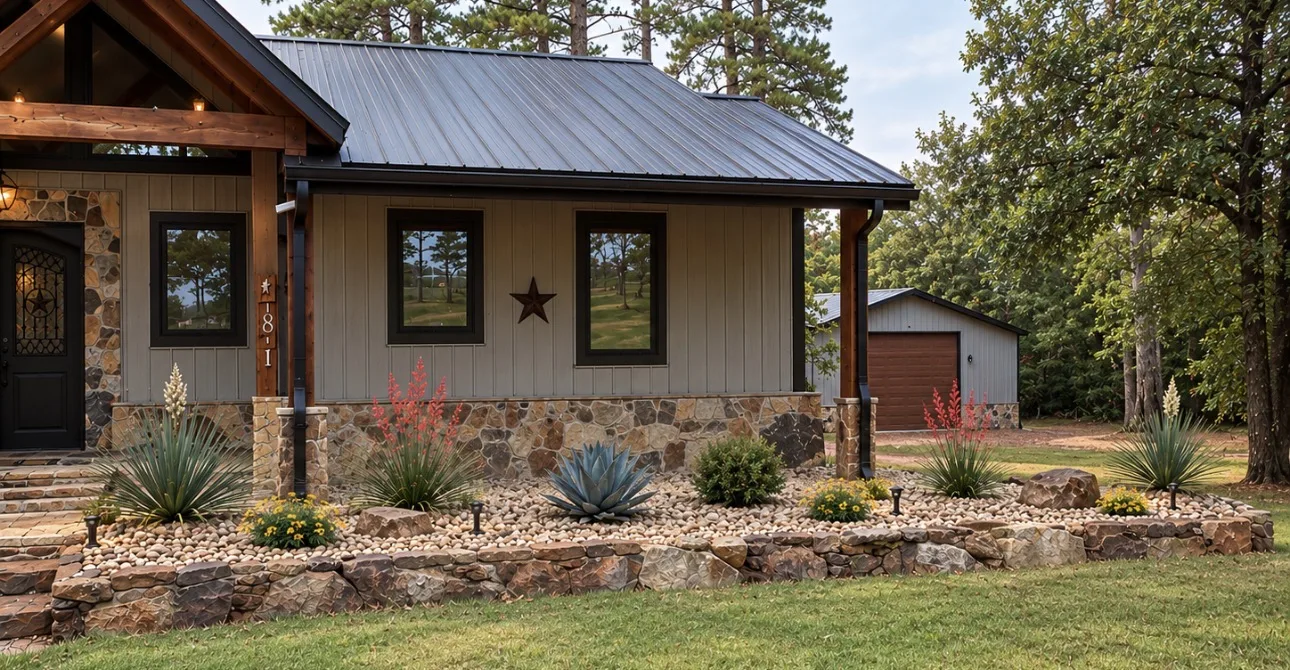
Not a true yucca, but a clump of narrow, arching leaves that sends up tall spikes of coral-red flowers from late spring into fall. It is about as close to zero-maintenance as a plant gets, and hummingbirds love it.
Good to know: It needs full sun and good drainage. It looks great in rock beds and along walkways, and the leaves have no sharp spines.
Evergreen shrubs for structure
Dwarf Yaupon Holly (Ilex vomitoria ‘Nana’)
A dense, rounded evergreen that is one of the best low-water replacements for boxwood. It stays green year-round, handles sun or part shade, and works for foundation plantings and low hedges.
Good to know: Taller yaupon varieties make excellent privacy screens, and the females carry red berries for birds in winter.
American Beautyberry (Callicarpa americana)
A loose, natural-looking shrub with clusters of bright purple berries in fall. It does well in part shade along the edge of woods and is a favorite food for birds.
Good to know: Cut it back in late winter. Berries form on new growth, so it will still fruit that fall.
Grasses
Gulf Muhly (Muhlenbergia capillaris)
A fine-textured grass that turns into a cloud of pinkish-purple plumes in fall. Plant it in groups or along a walkway for the best effect.
Good to know: Full sun and good drainage are a must. Trim it back in late winter before new growth starts.
Inland Sea Oats (Chasmanthium latifolium)
A shade-loving grass with flat, dangling seed heads that turn bronze in fall. It is a great choice for shady beds where little else will grow.
Good to know: It spreads by seed, so it works best where you want it to fill in an area.
Little Bluestem (Schizachyrium scoparium)
A native prairie grass with blue-green summer color that turns copper-orange in fall and holds through winter. Very drought tolerant once established.
Good to know: Give it full sun and lean soil. Too much water or fertilizer makes it flop over.
Small trees
Texas Redbud (Cercis canadensis var. texensis)
Covered in bright pink-purple blooms in early spring before the leaves come out. Its glossy leaves handle heat better than the eastern redbud. A great small tree for front yards.
Good to know: Plant it in fall so the roots can settle in before summer.
Mexican Plum (Prunus mexicana)
White, fragrant flowers in early spring, followed by small plums that wildlife love. It stays small and fits easily in most yards.
Good to know: Very drought tolerant once established, and it rarely needs pruning.
Tips for planting natives
- Plant in fall. Roots grow all winter in warm soil, so new plants are established before next summer’s heat. Fall is the best planting season in Texas.
- Water to get them started. “Drought tolerant” only applies once a plant is established. Water new plantings regularly through their first summer, then taper off.
- Match the plant to the spot. Check sun, shade and drainage before you plant. Many natives die from soggy soil, not from drought.
- Mulch. A 2 to 3 inch layer of mulch keeps roots cool, holds moisture and cuts down on weeds.
- Go easy on fertilizer. Most natives grow best without it. Too much feeding makes them leggy and weak.
- Group plants by water needs. Keep thirsty plants together and native plants together so you are not overwatering one to keep the other alive.
Want a low-water landscape without the guesswork?
Bassett Bro Landscaping designs and installs native and drought-tolerant beds across Northeast Texas, matched to your sun, soil and style. Contact us for a free estimate or call (903) 307-9169.